


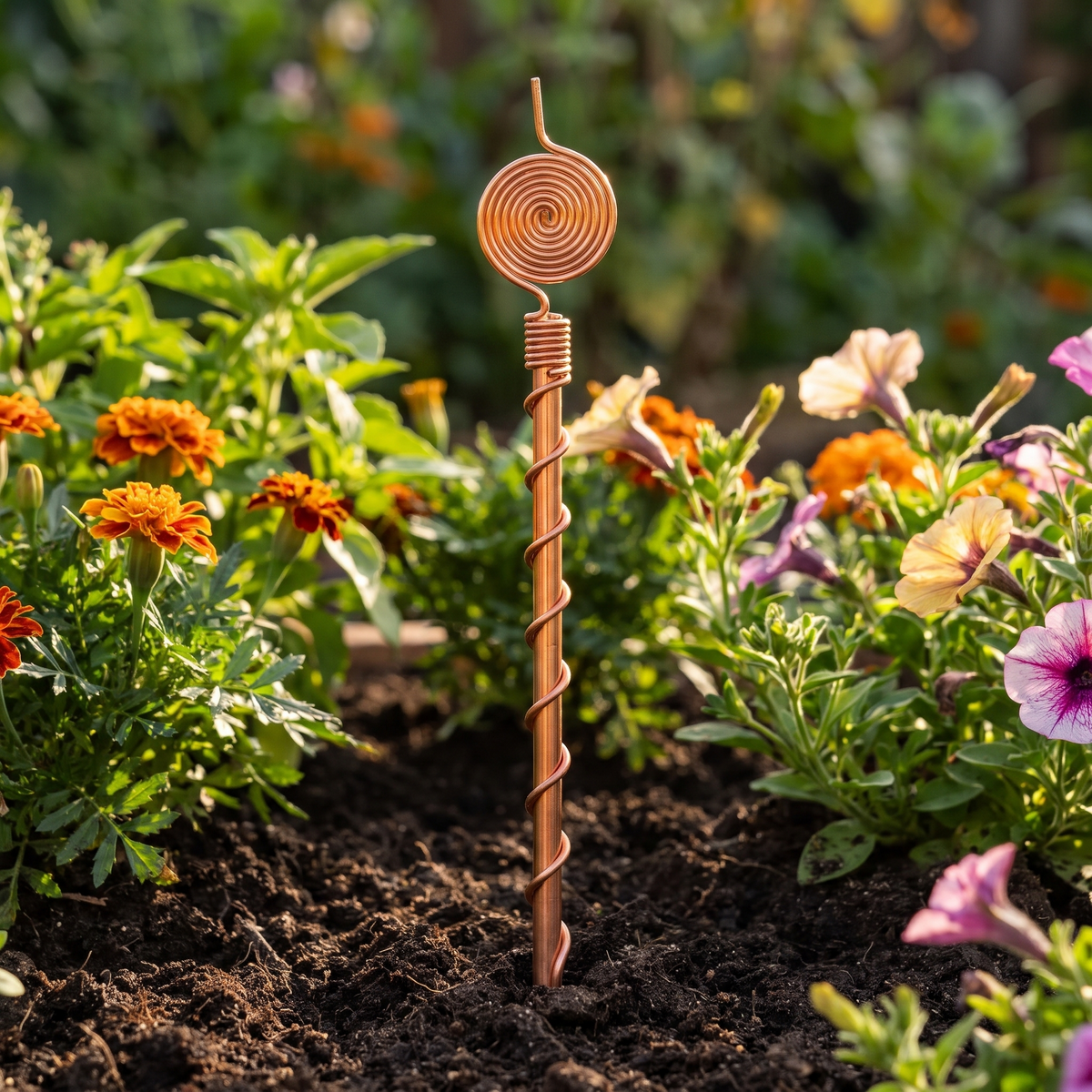

Last coils from Cass’s New Mexico workshop · In 5 active carts · 40 left
Cass’s Electroculture Copper Antenna

CASS BRENNAN · TAOS, NEW MEXICO
The Antenna Cass Started Winding After Her Garden Stopped Producing
Cass Brennan has grown food in the high desert outside Taos for eighteen years. Three years ago, after a particularly bad season, she started experimenting with electroculture — placing copper coil antennas in the soil to interact with the earth’s natural electromagnetic field and support plant root development. She now winds each antenna by hand, calibrated to a specific coil count and gauge she arrived at through three growing seasons of trial.
Pure copper. Hand-wound. Three options: a single coil for a raised bed or container, a garden set of three for a small plot, a full homestead pack of twelve for serious coverage. Cass plants hers eight to twelve inches deep, twelve to eighteen inches from the plant’s stem.
“The first year I tried it I got more tomatoes than I could give away. The second year I started winding for other people.”
Cass Brennan, high-desert grower & copper antenna maker, Taos, NM
WHY THIS PIECE
Three Details Worth Noticing
Pure copper, not copper-coated
Cass uses solid pure copper wire, not a copper-coated core that corrodes through over a season. The conductivity stays consistent as the metal ages — it oxidizes on the outside but stays copper all the way through.
Coil count calibrated over three growing seasons
Cass arrived at her current coil count and gauge by testing different configurations over three years of desert growing. She didn’t start from a theory — she started from what actually happened in her beds.
Sized for real placement depth
Each antenna is long enough to place at the eight-to-twelve-inch depth Cass recommends for root zone interaction. Not decorative. Not a topper. Something you put in the ground and leave there through the season.
FROM THE MAKER
Electroculture works because the soil already has an electrical charge moving through it. The antenna doesn’t add anything foreign — it’s copper in the ground, a conductor that helps the charge move more consistently around the root zone. Three seasons of my own data. I trust it.
Cass Brennan — high-desert grower & copper antenna maker, Taos, NM. Eighteen years growing in alkaline soil, three seasons of electroculture testing.
HOW IT COMPARES
A Different Kind of Piece
| What matters | This piece | Another approach |
|---|---|---|
| Material | Solid pure copper — conductive all the way through. | Copper-coated alternatives lose conductivity as the coating wears or corrodes. |
| Coil calibration | Coil count and gauge arrived at through three seasons of field testing. | Many electroculture products use generic coil specs not tested in a garden context. |
| Placement depth | Sized for 8–12 inch soil placement; root zone interaction. | Decorative or topper antennas don’t reach root depth. |
| Pack options | Single coil, garden set (3), full homestead (12). | Most are sold individually with no multi-bed pricing. |
PLAIN-SPOKEN DETAILS
What’s Here Before You Choose
An honest note
Electroculture is a practice with a growing body of practitioner evidence but limited controlled scientific studies. Cass’s results are from her own three-season desert trial. Results depend on soil composition, plant variety, and placement. This is not a guaranteed yield intervention — it’s a practice worth trying.
THE DETAILS
Specifications
| Product | Electroculture Copper Antenna |
| Material | Solid pure copper |
| Coil | Hand-wound, calibrated |
| Placement depth | 8–12 inches |
| Distance from plant | 12–18 inches from stem |
| Packs | 1, 3, or 12 |
| Made in | Taos, New Mexico, USA |
BEFORE YOU CHOOSE
Frequently Asked Questions
How does the electroculture antenna work?
Soil carries a natural electromagnetic charge. A copper coil placed in the root zone acts as a conductor, helping that charge distribute more consistently around the plant’s roots. The theory is that this supports cellular uptake, nutrient movement, and root development. Cass tested hers over three seasons in alkaline desert soil and saw consistent improvement in yield.
How many do I need?
One per raised bed or large container is a starting point. For an in-ground plot, one every six to eight feet of row is Cass’s working placement. The garden set of three covers a standard raised bed layout; the twelve-pack covers a serious kitchen garden.
Will the copper corrode?
Pure copper oxidizes — it will develop a green patina (verdigris) over time when exposed to soil and moisture. That’s normal and doesn’t affect conductivity. The copper remains copper all the way through. Pull them at the end of the season, brush off the soil, and store dry.
Is this scientific or folk practice?
Both, honestly. Electroculture has practitioner evidence going back decades and a growing number of small-scale growers reporting positive results. It lacks the double-blind agricultural trial data that other interventions have. Cass’s recommendation: try it on half your beds and compare.
Three Seasons of Desert Evidence
Cass started winding antennas because her garden needed it. She arrived at the coil count she uses now because it worked — in alkaline soil, in high-desert sun, over three consecutive seasons. Pure copper, hand-wound, sized for real placement depth. For the gardener who wants to try something that has a story behind it.
1,200+ Happy Customers
Excellent 4.9 ★★★★★
What Cass’s customers are saying

I put three of these in my raised tomato bed mid-June and by August the yield difference from my control bed was obvious. More fruit, less blossom drop. I’m ordering the 12-pack for next season.

Skeptic turned believer. I tried one antenna in a half-dead pepper plant that I was about to pull. Three weeks later it was putting out new growth. I can’t explain it but I can’t dismiss it either.

My squash beds with antennas produced noticeably more than the beds without. Same seeds, same soil prep, same water schedule. I’ve been gardening for fifteen years and this is the most curious result I’ve ever gotten.

Gift for my mom who has a large kitchen garden. She placed all twelve from the homestead pack in April. By July she was texting me photos of the biggest zucchini she’d ever grown. Now she wants to know if it works on fruit trees.
